
หน้าแรก / แบบฟอร์มคำนวณ / หูช้าง
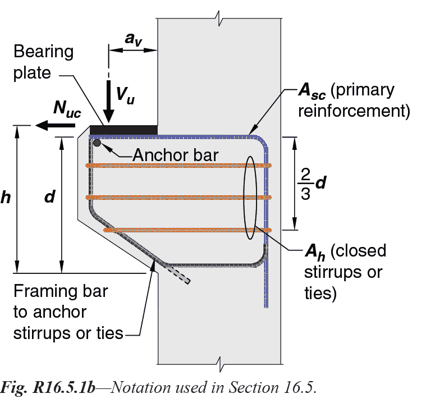
สัญลักษณ์ที่ใช้ในการคำนวณ (Fig. R16.5.1b)
Vu = แรงเฉือนประลัยที่กระทำ Nuc = แรงดึงในแนวราบที่กระทำ av = ระยะช่วงแรงเฉือน (shear span) h = ความลึกรวมหูช้าง d = ความลึกประสิทธิผล
Asc = เหล็กเสริมหลักรับแรงดึง (primary reinforcement) Ah = เหล็กปลอกปิด (closed stirrups) กระจายอยู่ในช่วง 2/3d จากผิวบน แผ่นรองรับ (bearing plate) วางบนหูช้าง รับแรง Vu ถ่ายลงเสา
ข้อมูลนำเข้า
หน่วย: ตัน (Tons), ksc, ซม. — ตามไฟล์ต้นฉบับ
Tons
Tons
ksc
ksc
ksc
—
—
—
cm
cm
cm
cm
cm
cm
cm
เหล็กเสริมที่ใส่จริง (Provide)
เส้น
mm
เส้น
mm
รายการคำนวณ
ผลลัพธ์
1
แรงออกแบบ
Vu = 1.4·V(DL) + 1.7·V(LL)
{{VuOut}} Tons
Nuc = 0.2·Vu
{{NucOut}} Tons
2
แผ่นเหล็กรองรับ (Bearing Plate)
ความยาวแผ่นที่ต้องการ = Vu/(φV·0.85fc'·W)
{{reqLPlateOut}} cm
พื้นที่แผ่นรองรับ = W × L(ใช้จริง)
{{plateAreaOut}} cm²
φVn(bearing) = φV·0.85fc'·A(plate)
{{phiVnBearingOut}} Tons
ตรวจสอบ: φVn(bearing) > Vu
{{bearingOut}}
fp(plate) = Vu / A(plate)
{{platefpOut}} ksc
โมเมนต์บนแผ่น M = fp·0.5·L²/4
{{momentPlateOut}} kg-cm
Fb = 0.75·fy(Plate)
{{FbOut}} ksc
ความหนาที่ต้องการ t = √(6M/(W·Fb))
{{reqPlateTOut}} cm
ตรวจสอบ: ความหนาที่ใช้จริง > ที่ต้องการ
{{plateTOut}}
3
ระยะช่วงแรงเฉือน a และความลึกประสิทธิผล d
ระยะช่วงแรงเฉือน a
{{aOut}} cm
Max Vn: 0.2fc' / (33.8+0.08fc') / 112.7 — ใช้ค่าน้อยสุด
{{maxVnOut}} ksc
d ที่ต้องการ = Vu/(φb·W·max Vn)
{{reqDOut}} cm
d ที่ใช้จริง = H − ระยะหุ้ม
{{dOut}} cm
ตรวจสอบ: d ที่ใช้จริง > ที่ต้องการ
{{dCheckOut}}
ตรวจสอบ: a/d < 1.00
{{aOverDCheckOut}} (a/d = {{aOverDOut}})
4
เหล็กเสริมรับแรงเฉือนเสียดทาน (Shear-friction)
Avf = Vu/(φb·fy·μ)
{{AvfOut}} cm²
5
เหล็กเสริมหลัก A(sc)
An = Nuc/(φb·fy)
{{AnOut}} cm²
Mu = [Vu·a + Nuc·(H−d)]/100
{{MuOut}} Tons-m
Rn = 100000·Mu/(φb·B·d²)
{{RnOut}} ksc
ρ = 0.85(fc'/fy)[1−√(1−2Rn/0.85fc')]
{{rhoOut}}
Af = ρ·d·B
{{AfOut}} cm²
As1 = (2/3)Avf + An
{{As1Out}} cm²
As2 = Af + An
{{As2Out}} cm²
As(min) = 0.04fc'·W·d/fy
{{AsMinOut}} cm²
As ที่ต้องการ = MAX(As1, As2, As(min))
{{reqAsOut}} cm²
พื้นที่เหล็กหลักที่ใส่จริง
{{areaAsOut}} cm²
ตรวจสอบ: As ที่ต้องการ/ที่ใส่จริง < 1.00
{{asCheckOut}} ({{asRatioOut}})
6
เหล็กปลอกปิด A(h)
Ah ที่ต้องการ = 0.5·(As ที่ใส่จริง − An)
{{reqAhOut}} cm²
พื้นที่เหล็กปลอกปิดที่ใส่จริง
{{areaAhOut}} cm²
ตรวจสอบ: Ah ที่ต้องการ/ที่ใส่จริง < 1.00
{{ahCheckOut}} ({{ahRatioOut}})
ระยะห่างปลอกปิด = (2/3)d / จำนวนเส้น
{{spaceAhOut}} cm
โมดูลคำนวณอื่นๆ ใช้งานได้แล้วทั้งหมด
การวิเคราะห์โครงสร้าง, คอนกรีตเสริมเหล็ก, ฐานราก, เหล็กโครงสร้าง (แป), แผ่นฐานเสา, จุดต่อโครงสร้าง, ระบบค้ำยันด้านข้าง, พื้นทางเดียว, พื้นสองทาง, พื้นไร้คาน (Flat Slab), ถังเก็บน้ำ, พื้นวางบนดิน, ฐานรากเสาเข็ม, เสาสั้น, เสายาว, แรงลม-ป้ายโฆษณา/กำแพง, แรงลม-อาคารเตี้ย, แรงลม-อาคารสูง, แรงแผ่นดินไหว-นอกแอ่งกรุงเทพฯ, แรงแผ่นดินไหว-ในแอ่งกรุงเทพฯ, รอยเชื่อม
90'S ENGINEER
© 2026 90'S ENGINEER · All rights reserved